HYROX Doubles or Singles? Choosing Your First Division

Thinking about your first HYROX but stuck on whether HYROX doubles or singles is the better call? This guide gives you a straight answer, a realistic prep timeline for your starting point and the race-day details first-timers tend to miss. We're writing from the box floor: BLN.Athletics in Berlin-Lichtenberg is an official HYROX partner, and plenty of our members are weighing up exactly this decision right now.
HYROX doubles or singles? The short answer for your first race
Our rule of thumb for a first race: pick relay if you want a taste. Pick doubles if you want the full course but would rather share the work at the stations. Pick singles if you can run 5 to 8 km without stopping and can get through every station on your own. Whichever format you choose, as a beginner you start in the Open division. Pro is aimed at experienced racers and uses heavier weights.1
Worth knowing: according to the organisers, HYROX is for anyone with a base level of fitness. The minimum age is 16 and there is no time limit.2 You don't need to be fast to reach the finish line.
Singles, doubles, relay: the formats side by side
The structure never changes. You run 1 km, hit a station, and repeat that eight times. In order, the stations are a 1,000 m SkiErg, sled push, sled pull, 80 m burpee broad jumps, a 1,000 m row, 200 m farmers carry, 100 m sandbag lunges and 100 wall balls.1 The format only changes who runs and who does the work.
- Team – Singles: solo; Doubles: pair; Relay: four people
- Running – Singles: 8 x 1 km alone; Doubles: 8 x 1 km together; Relay: 2 x 1 km per person
- Stations – Singles: all 8 alone; Doubles: work at each station split as you like; Relay: 2 stations per person
- Weights for beginners – Singles: Open; Doubles: Open; Relay: Open
- Pick this if … – Singles: you can comfortably run 5 to 8 km and handle every station alone; Doubles: you want the full course, just not on your own; Relay: you want a taste or want to race with friends
Formats as described by HYROX.12 The last row is our coaching advice, not an official rule.
Open weights at a glance
Doubles and relay use the Open weights for each category.1
- Sled push – Open women: 102 kg; Open men: 152 kg
- Sled pull – Open women: 78 kg; Open men: 103 kg
- Farmers carry – Open women: 2 x 16 kg; Open men: 2 x 24 kg
- Sandbag lunges – Open women: 10 kg; Open men: 20 kg
- Wall balls – Open women: 4 kg; Open men: 6 kg
Mixed teams have their own specifications. Check the current rulebook for your division on hyrox.com before you register, as details can change from season to season.

Doubles isn't automatically easier
Doubles sounds like half the work. On the run, it isn't, because you cover all eight kilometres together.2 There's no catching your breath while your partner does a lap. Your pace is set by whoever is slower on the day.
At the stations you can split the work however you like.1 That's a real advantage if you have a plan, and a time sink if you start negotiating in front of the sled. Agree beforehand who pushes which metres and how you'll rotate on wall balls and lunges.
Choosing a partner
- Running pace beats strength. You run all eight kilometres side by side, while the strength work can be shared. A similar running pace matters more than a similar deadlift.
- Same expectations. Are you chasing a time or aiming to finish with a smile? Sort that out before you sign up.
- Coach's tip from the box: both of you should be able to complete every station alone. If one partner stalls on the sled push, the whole station lands on the other, and that costs more energy than any lap of running.
How long should you prepare?
There's no fixed rule, but beginner guides give useful benchmarks. Training provider Edge Hybrid suggests these blocks of focused preparation:4
- New to running and the gym – Preparation: 16 to 20 weeks
- Regular gym-goer, little running – Preparation: 12 to 16 weeks
- Regular runner, little gym work – Preparation: 12 to 14 weeks
- Active in strength and endurance (e.g. CrossFit plus running) – Preparation: 8 to 12 weeks
If you already do CrossFit or functional training regularly and can run 5 km without stopping, you're probably looking at 8 to 12 weeks. If you're close to starting from scratch on both, plan for 16 to 20. Squeezing a 16-week block into 8 weeks by training twice as often doesn't give you the same result, according to the same guide.4 These numbers are based on coaching experience, not study results.
What those weeks are for
- Aerobic base: easy runs at a pace where you can still hold a conversation, so the eight kilometres between stations don't become your main problem.
- Station technique: clean wall balls, an efficient rowing stroke, a solid position behind the sled.
- Combo sessions: run plus station, for example 1 km followed straight away by 20 wall balls. That's how you get used to the switch that catches a lot of people out in their first race.
A sample week alongside work and life
You don't need an elite programme. Three to four sessions a week is a framework you can realistically keep up next to a job and a family.
- Session 1: HYROX class with stations and combo workouts
- Session 2: CrossFit or functional class for strength and technique
- Session 3: easy run, 30 to 45 minutes at conversation pace
- Session 4 (optional): combo session, such as 4 rounds of a 1 km run plus one station
- At least one rest day: locked into your calendar, for recovery
Two to three weeks out from race day, a dress rehearsal pays off. In October, BLN.Athletics hosted a HYROX simulation as a dress rehearsal, and the BLN Hybrid Race lets you test running and stations in competition mode. Ask your coach when the next chance comes up.
Race day: what first-timers underestimate
- Arrive with time to spare. Check-in, changing, warming up and finding your start wave take longer than you'd think. Give yourself room.
- The Roxzone. Between each run and station you move through the Roxzone, the transition area. The clock keeps running there, so factor in the walking. According to HYROX, water is available at least once before or after each pass through the Roxzone.2
- The first two kilometres. Music, a packed hall, adrenaline: many people go out too fast. Run the first two laps a touch slower than planned.
- Wall balls at the end. 100 reps after seven stations is where the race gets mental. Decide on your sets in advance, say 10 x 10 or 5 x 20, and stick to the plan before your legs start making the decisions.
When can you race? Season 26/27 dates
The official HYROX race calendar currently lists these races in Germany (as of 12 October 2026):35
- Hamburg – Dates: 28 Oct to 1 Nov 2026
- Düsseldorf – Dates: 11 to 15 Nov 2026
- Frankfurt am Main – Dates: 10 to 13 Dec 2026
- Cologne – Dates: 8 to 11 Apr 2027
Work backwards from the race you want. Hamburg, Düsseldorf and Frankfurt leave beginners very little prep time, so those are better for cheering from the stands. Between mid-October and Cologne, on the other hand, there are roughly 24 weeks. That's enough even if you're starting close to zero. If you want to race in spring, now is the time to start. HYROX keeps adding events, so check the calendar again before you commit.
Train together: HYROX at BLN.Athletics in Lichtenberg
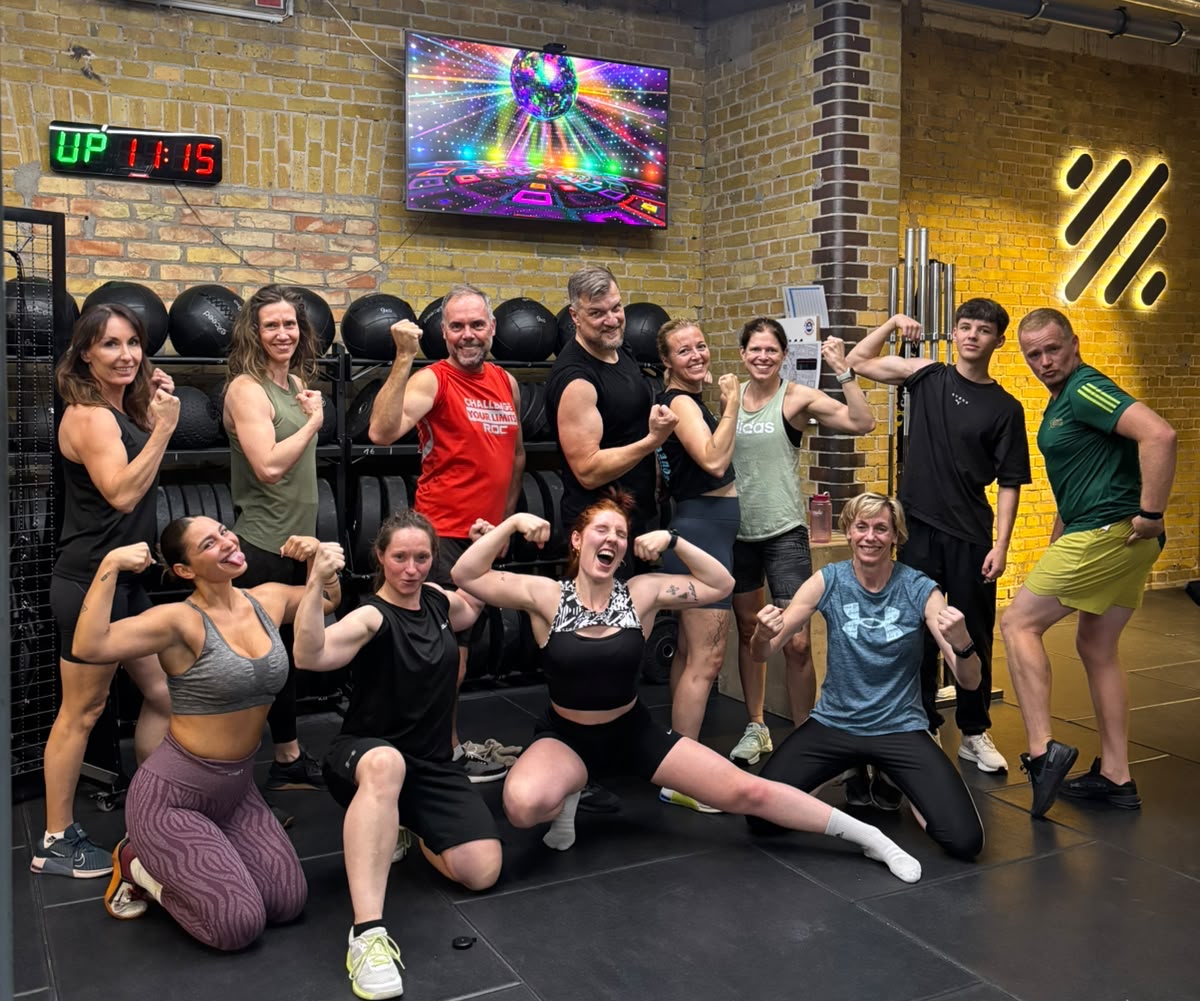
Training for a race on your own is a grind, especially once it gets dark early. In a group you have fixed sessions and people chasing the same goal. BLN.Athletics is an official HYROX partner, and in our HYROX classes at BLN.Athletics you combine running, ergs and functional movements in one workout.
Talk to the people next to you in class. That's where you're most likely to find someone with a similar running pace for doubles, or three teammates for a relay.
FAQ
Is HYROX doubles easier than singles?
At the stations, yes, because you share the work. On the run, no: you complete all 8 x 1 km together.2 For many beginners doubles still feels like the more relaxed start, because someone is running right beside you.
How long does it take to prepare for HYROX?
Between 8 and 20 weeks, depending on where you start.4 With a strength and running base, think 8 to 12 weeks. As a complete newcomer, more like 16 to 20.
Can beginners do HYROX?
Yes. According to the organisers, HYROX is for anyone with a base level of fitness, from age 16, with no time limit.2 Start in the Open division, ideally as doubles or relay.
Do you have to run together in HYROX doubles?
Yes. You run together and only split the work at the stations.1
What's the difference between HYROX Open and Pro?
Same format, but Pro uses heavier weights and is aimed at experienced racers.1 On the sled push, for example, women push 152 instead of 102 kg and men 202 instead of 152 kg.
How does HYROX relay work?
Four people share the race. Each runs 1 km twice and takes on two stations.2
Bottom line
There's no wrong division for a first race, only one that fits your current level better. Relay for a taste, doubles for the full course with backup, singles once running and stations feel solid. Plan 8 to 20 weeks depending on your starting point and count back from the race you want.
Try a HYROX class at BLN.Athletics in Lichtenberg and find your doubles or relay crew there. Book your free trial
More tips on Instagram: @bln.athletics
Sources
- HYROX: The Fitness Race
- HYROX UK: FAQ
- HYROX (2026): Find my race (season 26/27)
- Edge Hybrid Ltd (findyouredge.app) (2026): How long to train for HYROX
- HYROX (2026): HYROX Hamburg, Season 26/27